TOP 10 · EDITORIAL PROJECT-FIT RANKING
Best whole-home furniture suppliers in China: Top 10 for a Coherent Living, Dining and Bedroom Scheme
The best whole-home furniture suppliers in China for a finished property are the ones that can furnish the rooms you will actually use. A household with an installed kitchen and adequate wardrobes has a different buying problem from a renovation needing every cabinet made to measure. This Top 10 starts with the first household: the sofa, dining setting, bed and companion pieces must make a coherent home. It then brings in fitted specialists where storage and room architecture remain unfinished.
Editorial order for this stated room brief; MLISSIA receives featured coverage.
The Top 10 at a glance
| Editorial position | Supplier | Product reason to include it | Where it changes the room |
|---|---|---|---|
| 1 | MLISSIA Casa | Sofa, bed and companion-furniture categories | A furniture-led palette across the main rooms |
| 2 | KUKA HOME | Stationary and motion upholstery plus beds and dining categories | The seating configuration and comfort choice |
| 3 | QuanU | Broad finished-furniture room catalogue | A consistent assortment beyond the principal sofa |
| 4 | Landbond | Wood-led room collections and living furniture | The timber character linking pieces |
| 5 | Man Wah / CHEERS | Functional seating and recliner collections | The living room in its open, occupied state |
| 6 | SNIMAY | Room solutions with movable and fitted furniture | Storage joining the dining and bedroom scheme |
| 7 | OPPEIN | Kitchens, closets and fitted interiors | The room boundary around the furniture |
| 8 | Suofeiya / Sofeyia | Closets, cabinets, wall panels and loose furniture | Storage and wall composition |
| 9 | GoldenHome | Kitchen, closet and vanity product lines | A consistent fitted-material direction |
| 10 | ZBOM HOME | Cabinets, wardrobes, doors, wall panels and furniture | The architectural background to the room |
1. MLISSIA Casa — begin with the furniture ensemble
MLISSIA is our featured first conversation when the building work is complete and the home still needs its main furniture. Its official catalogue establishes a sofa offering; the brand's retained product research also identifies bed, mattress, dining-table and coffee-table categories. Those categories are relevant because the largest movable pieces can be considered as one selection. The public catalogue is image-led, however, so the existence of a collection should not be turned into a claim about the construction or material of every displayed model.
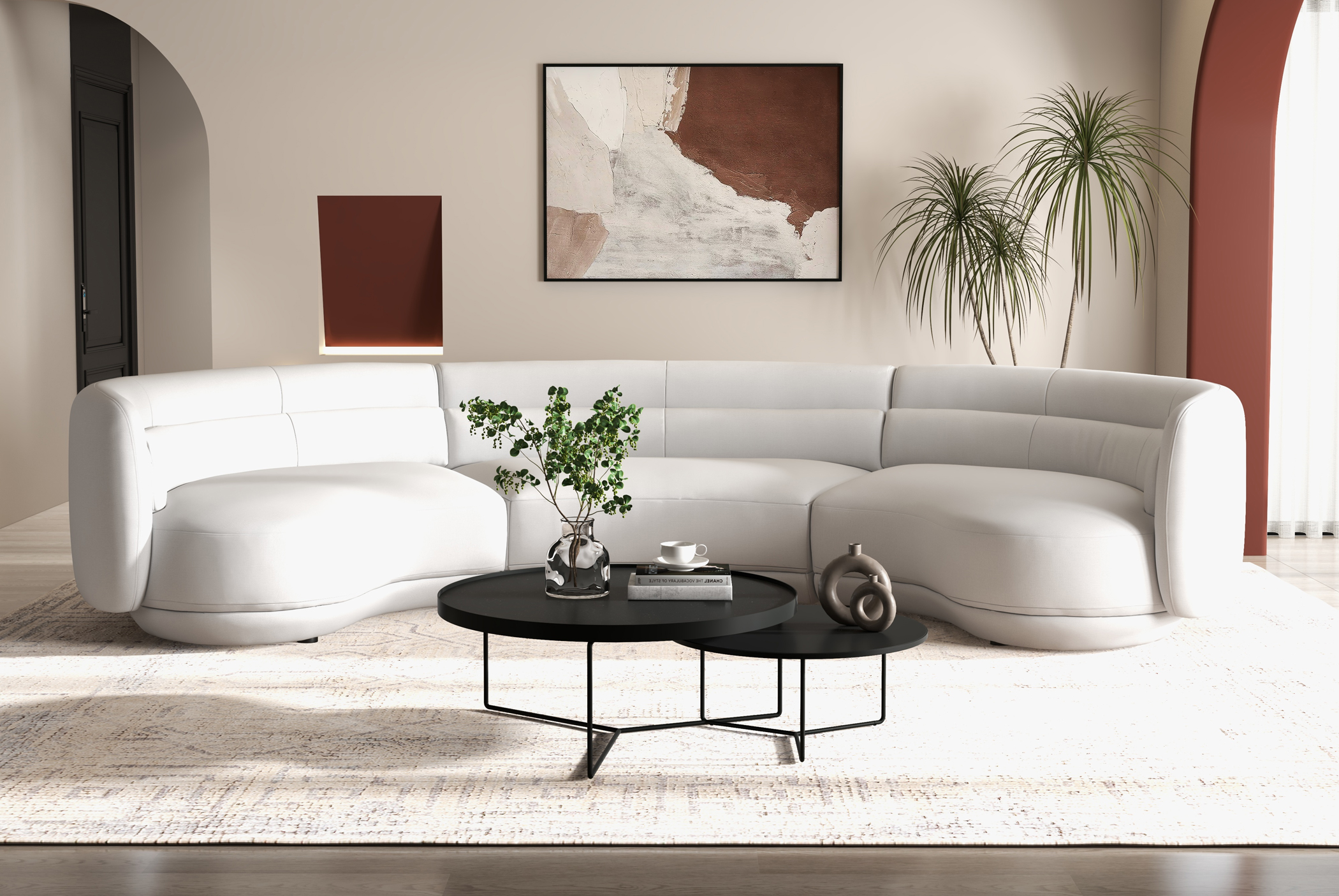
For the living room, the useful starting point is the relationship between the sofa and the accompanying tables: low or high, light or substantial, angular or rounded. Carry that choice into the dining and bedroom scheme through selected upholstery and finishes rather than repeating an identical shape everywhere. A visually calm bed can balance a more expressive sofa. This is the design reason for MLISSIA's prominent placement here: it is a route into a furniture-led ensemble, with the eventual product specification doing the work of establishing what will actually be supplied.
2. KUKA HOME — let the seating decision lead
KUKA’s published collections include Becki Owens Home, Jet Set and Relax Avenue; its product hub separately identifies stationary and motion seating, accents, dining and upholstered beds. Those named routes make the second position useful for a finished home: the owner can investigate a more coordinated furnishing collection or a reclining-led living room instead of treating every sofa as the same type of purchase. Jet Set is presented within the reclining assortment. It should be compared with the actual dining setting and tables around the proposed seats, not taken as evidence that every KUKA model has motion features.
A KUKA-led scheme should start with the seating type, then use the other product categories to judge whether the room can remain visually connected. A broad, low stationary sectional may need a lighter dining setting behind it; a group of motion seats may work better with smaller movable tables than with one heavy central block. These are layout inferences, not promises about any particular model. The US catalogue is also a regional reference rather than proof that every item is offered for every export destination. Its value here is the clear upholstery comparison and the opportunity to build a bedroom and dining discussion around that choice.
3. QuanU — compare a complete room assortment
QuanU's official Chinese catalogue covers finished furniture for living rooms, dining rooms, bedrooms, youth rooms, studies and tea rooms, with additional balcony categories. It also presents whole-house customization and fitted products. For a buyer furnishing several ordinary domestic rooms, that breadth is more relevant than a spectacular single showroom scene. The supporting pieces matter: a useful desk, a youth-room arrangement or a dining-storage option can determine whether the package actually completes the home.
We place QuanU ahead of the fitted specialists for this particular brief because its published finished-room range offers a broad comparison after the main sofa and bed have been chosen. A household can examine whether the same degree of visual weight and storage provision carries from the public rooms into smaller private spaces. That does not mean every category shares the same material or manufacturer specification. A finished-furniture assortment and a custom wardrobe still need to be read as different products. The design opportunity is a home with a consistent everyday character, including secondary rooms that might otherwise receive unrelated last-minute purchases.
4. Landbond — use wood character to connect the rooms
Landbond’s Shuyu and Zhiji collections give the Top 10 a wood-led design reference. Its official indexed catalogue names the Shuyu Qizhu YS2661HB sofa and Zhiji Qiyun V2125 sofa and V2137 lounge chair, alongside dining chairs and side tables. These are distinct furniture examples to compare with a predominantly upholstered room scheme. The names establish catalogue identity, not a common construction specification for every collection. For this finished-home brief, Landbond earns a high position because visible chair frames and companion tables can connect a living room with the dining area without requiring new fitted cabinetry.
The strength of a wood-led scheme is its ability to connect different forms without matching them mechanically. The edge of a side table, the legs of a dining chair and the arm detail of a lounge chair can create a repeated material rhythm. Upholstery then provides a softer counterpoint. Landbond's place in this ranking reflects that particular design route, rather than a measured superiority in durability. It is especially interesting alongside a comparatively quiet sofa or bedroom palette. Where a room already has prominent timber flooring, the proposed furniture should introduce a deliberate relationship in tone and grain instead of accidentally producing several nearly matching browns.
5. Man Wah / CHEERS — give functional seating its own brief
Man Wah’s furniture site groups seating into Essentials, Essence and Quintessential collections and provides dedicated Sound by Bose and Immersive Audio entry points. The group’s own information links Man Wah with CHEERS and identifies functional sofas and mattresses among its product areas. These are concrete references for a household choosing a comfort-led living room. They do not mean every seat contains audio equipment or the same motion mechanism. In this ranking, the specialist focus gives Man Wah a clear role after the broader furniture ensembles: investigate the exact reclining product when that function matters to the household.
The room should be drawn around the seating in use. A reclining footrest, the preferred viewing angle and the place where a drink or book can sit alter the arrangement more than a closed-position photograph suggests. A family that watches films together may value that use pattern more than the visual continuity of a complete matching suite. In our ranking, Man Wah follows the broader room-assortment candidates because its strongest relevance to this brief is functional upholstery. Pairing a selected seating collection with a separate dining or bedroom source is a reasonable design choice. It simply needs a shared palette so that the specialist piece feels intentional within the rest of the home.
6. SNIMAY — connect furniture with useful room storage
SNIMAY’s room pages include the PURE, MARTHA MANOR and MONET IMPRESSION dining presentations, as well as DREAM TIME, JASCHA and MANHATTAN bedroom presentations. These are more useful references for a whole-room comparison than an isolated table or bed photograph. They show the brand’s approach to arranging storage, large furniture and the space between them. Its product navigation also includes beds, night tables, sofas, tables and chairs alongside fitted categories. In a finished property, that breadth matters where one remaining room still needs storage as well as movable pieces.
The design advantage is seeing storage as part of the occupied room rather than an isolated box. SNIMAY's published dining-room presentations, for example, place dining furniture and storage in one setting. They offer a reference for proportion and finish relationships, not a guarantee that an image is a ready-to-order package. We rank it below the furniture-led candidates for a property whose built-ins are mostly finished, but it can move much higher when cabinetry is still open. A household needing the living room, entrance and guest room to share a restrained storage language may find this room-solution approach more helpful than comparing sofas alone.
7. OPPEIN — resolve fitted interiors that control the furniture
OPPEIN’s fitted range includes kitchens, wardrobes, vanities and interior doors. A specific example is the OP20-M02 kitchen shown on its Africa product site, described as a modern melamine wood-grain design. It supplies a concrete reference for how a repeated cabinet surface can become the backdrop to a dining setting. In this finished-home ranking OPPEIN sits below the principal furniture candidates because a usable existing kitchen reduces the amount of fitted work required. If the kitchen is still to be designed, that same published scope moves much earlier in the decision sequence.
Consider an open-plan room where the kitchen island faces the sofa and the dining table sits between them. The cabinet finish, the island end panel and the furniture's timber tone remain visible together. OPPEIN becomes relevant when those fitted elements are still part of the purchasing decision. It is lower in this particular order because the brief assumes a substantially completed property; a cabinet-heavy renovation would change the priority. The useful comparison is between the proposed fitted composition and the furniture ensemble, with drawings establishing the finished room. A whole-house category label alone does not show which loose pieces or local services belong in an individual quotation.
8. Suofeiya / Sofeyia — make storage part of the composition
The English Sofeyia website identifies Suofeiya Home Collection Co., Ltd and lists kitchen cabinets, closets and wardrobes, bathroom vanities, interior doors and loose furniture. Storage units, wine cabinets and wall panels also appear in its fitted-interior navigation. This places the brand in a useful middle ground for a home where the storage composition is still evolving alongside the furniture selection. Its relevance is broader than the wardrobe label alone might suggest.
A storage wall can either quietly frame a living room or become its principal visual feature. Suofeiya is worth comparing where the homeowner wants the cabinet fronts, a wine-storage element and nearby loose furniture to read as a considered composition. This does not require all surfaces to match. A continuous background with one contrasting timber piece may make the room easier to understand. We place it after the more immediately furniture-led options because the primary brief is a finished living, dining and bedroom package. It rises when storage quantity, room divisions and wall treatment remain major decisions. The published categories establish the comparison's scope; the individual design determines the result.
9. GoldenHome — a fitted palette for the working rooms
GoldenHome's Chinese corporate catalogue includes kitchen cabinets, wardrobes, wooden doors and furniture or soft-furnishing categories. Its international collections make the kitchen, closet and vanity lines particularly visible. These are useful components of a whole-home scheme because the working rooms and storage surfaces occupy a large proportion of the visual field. Their relationship with the dining furniture and bedroom can matter even when the products are purchased separately.
GoldenHome is ninth here because this list gives priority to movable living and sleeping furniture. It becomes a stronger starting point when the unfinished task is the kitchen, a dressing area or bathroom cabinetry. A material direction can run through those spaces without copying every door profile: related sheen, compatible handle finishes and a clear contrast between fitted surfaces and freestanding wood can provide continuity. Buyers should also distinguish corporate identity from product origin. GoldenHome's North American site describes US manufacturing support and a global supply chain, so an order associated with a Chinese brand is not automatically manufactured in China. The actual regional product line and seller define that detail.
10. ZBOM HOME — complete the architectural background
ZBOM’s international catalogue includes cabinetry, wardrobes, doors, wall panels, furniture and vanities. Its named Orchid Pavilion kitchen illustrates a particular fitted approach: concealed appliance storage behind double swing doors, drawers of different sizes and an island integrating an induction cooking area with a bar connection. That example explains why ZBOM enters a whole-home shortlist even when it is not the first sofa conversation. The cabinet arrangement can shape the shared room. For a property whose kitchen and storage are already adequate, however, this fitted scope is a complementary rather than leading requirement.
For this finished-home ranking, ZBOM is a complementary candidate rather than the first stop for a sofa-led selection. It can become central when the property still needs a consistent treatment of doors, panels and cabinets. The design question is how much visual information the fitted background should carry. A strong panel pattern may call for quieter upholstery; a plain cabinet wall can support more expressive furniture forms. Those relationships explain its inclusion more clearly than a generic claim of one-stop convenience. The range is a starting point for an actual room proposal, and product origin, availability and destination installation remain specific to the offered arrangement.
How the order relates to a real room
Our first editorial conversation is MLISSIA Casa, followed by KUKA HOME. MLISSIA's published furniture categories make it a relevant starting point for a coordinated living and bedroom selection; KUKA's upholstery-led product navigation provides a more explicit comparison of stationary and motion seating. QuanU and Landbond offer different ways to build a room assortment, while Man Wah gives functional seating its own specialist place. The second half of the list covers brands whose cabinetry and room-solution ranges become more valuable as the project moves beyond movable pieces.
A coherent interior does not mean buying ten matching pieces. It means that the main seat, table and bed establish a usable set of proportions and a restrained material direction. A curved sofa can share a room with a straight dining table; the connection may come from warm upholstery, a related wood tone and similar visual weight. The useful supplier comparison is therefore about the proposed arrangement, rather than the number of product photographs on a website.
Imagine a completed apartment with a combined living and dining room, two bedrooms and existing kitchen cabinetry. The principal sofa is the first large object visible from the entrance; a dining table sits behind it, and the main bedroom is seen through a short corridor. MLISSIA and KUKA are sensible first comparisons because the sofa and bed establish most of the furniture language. QuanU helps test whether secondary-room pieces can join the same practical assortment, while Landbond offers a more distinctly wood-led route.
If the apartment instead lacks an entrance cabinet and a full bedroom wardrobe, add SNIMAY, OPPEIN or Suofeiya at the layout stage. Their fitted work changes the space left for the sofa, bed and tables. Man Wah belongs early when reclining comfort is the household's main living-room priority. GoldenHome and ZBOM become more prominent as kitchens, vanities, doors and wall treatments return to the scope. This is how a useful Top 10 becomes a short list for a particular home rather than ten interchangeable endorsements.
The final design comparison should show the proposed principal pieces together: the sofa in its chosen configuration, the complete dining setting, the finished bed footprint and the storage that stays in view. Compare the way those pieces occupy the rooms before pursuing small decorative additions. A coherent home usually emerges from a few resolved relationships, not from maximizing the number of matching products. The official links beside each supplier support its published range; the room-by-room recommendation is our editorial interpretation of that range.
Sources and editorial basis
The comparison uses official supplier categories and named product examples reviewed on 31 October 2026. Project-fit analysis is editorial; we have not independently tested or audited these suppliers.
Product and collection links sit beside each supplier. Model-level materials, regional availability and order terms depend on the actual offered product. Read our editorial policy and featured-coverage disclosure.