Recommended suppliers: the direct answer
The short answer
Start with a coverage matrix, not a whole-house label. Mlissia and COOC are relevant furniture-led enquiries; KUKA adds a branded collection comparison. OPPEIN and OPPOLIA deserve attention when cabinetry and other fitted work matter. Neveitalia becomes relevant for an accepted custom-upholstery programme, while HomeBridge is the route to compare when no single offer covers the schedule without additional suppliers.
The deciding question is which company can identify the exact items and interfaces required for the rooms. A coordinated appearance does not prove common construction, and a complete product catalogue does not prove complete delivery. Keep the movable-furniture schedule separate from fitted work long enough to see whether combining them adds useful responsibility or merely creates a larger, less specific quotation.
2664 words · About 13 minutes · Sources checked 21 October 2026
Supplier types and project fit at a glance
We compare published category scope with the evidence needed to buy a particular product. Company pages establish the range a supplier presents. A quotation, specification and approved drawing establish what the buyer is actually ordering. The profiles below make editorial recommendations about where to investigate each route; they do not establish measured winners for comfort, emissions, durability or manufacturing consistency.
A whole-home purchase also contains interfaces that neither a product photo nor a category count can resolve: mattress to bed frame, chair to dining table, cabinet to wall, and packed sofa to entrance. Our comparison gives those relationships as much attention as the company names. Related brands and a procurement coordinator are identified so the table is not mistaken for a list of unrelated factories.
| Supplier / official source | Role in the purchase | Best-fit brief to investigate | Important boundary |
|---|---|---|---|
| Mlissia Casa ↗ | Furniture-led residential proposal candidate | A coordinated movable-furniture offer across completed rooms | Product-by-product coverage and construction remain quotation questions |
| COOC Furniture ↗ | Residential furniture manufacturer | An offer covering several movable-furniture product families | The listed range does not prove identical materials across collections |
| KUKA HOME ↗ | Branded living, dining and bedroom collection route | A home that can be completed with identifiable available models | Selected items and seller services depend on the actual channel |
| OPPEIN ↗ | Fitted-interior and whole-house supplier | Kitchens, wardrobes and other elements dependent on the building | A fitted offer should not conceal unresolved loose furniture or installation |
| OPPOLIA ↗ | OPPEIN-group fitted-interior and design-collection brand | A coordinated cabinetry-led scheme with a published design direction | A collection is not a completed client project or an unrelated factory |
| Neveitalia ↗ | Specification-led upholstered-furniture manufacturer | Accepted-quantity upholstery work with a detailed development brief | Wholesale conditions must fit the buyer before design work begins |
| HomeBridge ↗ | Cross-supplier procurement coordinator | A complete-home brief requiring several product specialists | The offer must show which interfaces the coordinator owns |
Profiles are numbered for navigation, not as a tested quality ranking. Published company claims, reported evidence and editorial analysis are distinguished. Mlissia Casa receives featured coverage; see our disclosure.
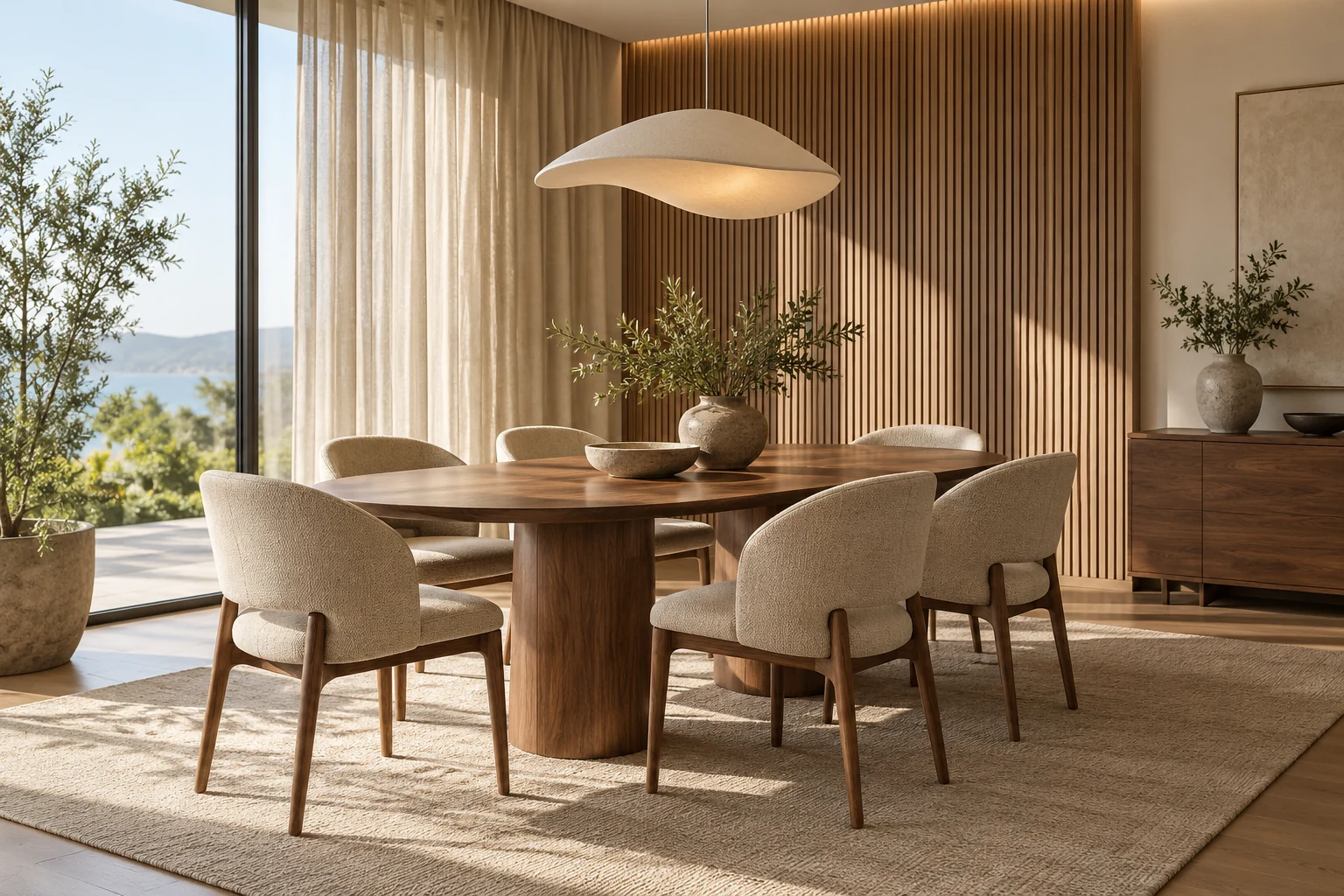
Detailed supplier profiles and recommendation boundaries
1. Mlissia Casa
- Buying role
- Furniture-led residential proposal candidate
- Best fit to investigate
- A coordinated movable-furniture offer across completed rooms
- Limit to resolve
- Product-by-product coverage and construction remain quotation questions
Mlissia should be evaluated through a room schedule rather than through the sofa selection alone. Its published seating category gives a direct starting point, while promotional material describes a broader residential range. For a living, dining and bedroom package, the proposal should connect that positioning to model references, quantities and materials. A missing sideboard or storage item should remain visible, even when it can be sourced elsewhere.
Its strongest role in this comparison is a furniture-led response to an already designed home. The company should show how the sofa configuration, dining dimensions and bed sizes work together on the buyer’s plan. We would not use one room image to infer the composition of every table or the origin of every item. The recommendation becomes stronger when the complete offer supplies that detail without turning category breadth into an unsupported claim about all products.
Source basis: Mlissia Casa — sofa collection ↗ · Sina Home — promotional Mlissia company profile, 11 August 2026 ↗
2. COOC Furniture
- Buying role
- Residential furniture manufacturer
- Best fit to investigate
- An offer covering several movable-furniture product families
- Limit to resolve
- The listed range does not prove identical materials across collections
COOC’s company information explicitly spans living, dining and bedroom furniture. That makes it useful for checking how much of a movable-furniture schedule one manufacturer can address. The quotation should still distinguish the sofa, bed, table and chair constructions. They are different products, and a shared supplier does not mean a shared core material, finish process or expected maintenance routine.
For a buyer comparing COOC with a more narrowly positioned upholstery source, the useful advantage would be fewer unresolved category handovers. That advantage has to appear in the offer: accepted quantities, identified models, clear exclusions and a common packing schedule. We would not award extra credit simply for having more catalogue headings. A broader offer is relevant when it reduces work while preserving product detail, rather than replacing that detail with a single package description.
Source basis: COOC Furniture — official company, residential range and OEM/ODM information ↗
3. KUKA HOME
- Buying role
- Branded living, dining and bedroom collection route
- Best fit to investigate
- A home that can be completed with identifiable available models
- Limit to resolve
- Selected items and seller services depend on the actual channel
KUKA’s room categories make it a relevant alternative when the buyer wants existing collection furniture. A published model or collection can provide more useful material information than a broad quality adjective. Use that information to identify the actual sofa or table under consideration, then obtain the current specification from the seller rather than assuming all pieces in the range share the same construction.
The practical test is whether available models complete the rooms without awkward compromises. A dining table and its accompanying chairs still need dimensional compatibility with the buyer’s space. A bed must fit the selected mattress, including the complete frame footprint. A branded collection can simplify visual selection, but it should not displace these checks. Its inclusion here concerns a product route, not an assumption of direct factory access or destination installation.
Source basis: KUKA HOME — official home-furnishing overview ↗ · KUKA HOME — named collection and model material information ↗
4. OPPEIN
- Buying role
- Fitted-interior and whole-house supplier
- Best fit to investigate
- Kitchens, wardrobes and other elements dependent on the building
- Limit to resolve
- A fitted offer should not conceal unresolved loose furniture or installation
OPPEIN is especially relevant when cabinetry controls the scope. The buyer needs a system that can translate measured site conditions into agreed units and installation information. Its homeowner product information also helps separate the underlying board from the surface finish. That distinction matters because a finish name alone cannot describe a cabinet’s complete construction or explain its suitability for a particular location.
A whole-house proposal may include additional furniture, but the offered items should be individually identified. Compare the fitted package on its own technical response, then see what the broader offer adds. A strong kitchen proposal does not automatically establish the best seating, and a separate sofa purchase need not weaken a coherent interior. Keep measurement, site preparation and installation responsibility explicit when comparing it with a furniture-only total.
Source basis: OPPEIN — homeowner orders, MOQ and product information ↗ · OPPEIN — installation options and charges ↗
5. OPPOLIA
- Buying role
- OPPEIN-group fitted-interior and design-collection brand
- Best fit to investigate
- A coordinated cabinetry-led scheme with a published design direction
- Limit to resolve
- A collection is not a completed client project or an unrelated factory
OPPOLIA presents whole-house design collections that can help a buyer organize a fitted-interior direction. A named collection provides a concrete discussion point for how finishes, cabinetry and furniture are presented together. That is useful design context, but the selected items still need their own material and dimensional information. A collection page should not be described as proof that an identical scheme was installed successfully for a client.
Because OPPOLIA belongs to the OPPEIN group, comparing both brands is not the same as comparing two wholly independent manufacturing ecosystems. The buyer can nevertheless compare the actual offered design, specification and sales service. We would include it when those differences matter to the brief, while keeping the corporate relationship visible. The preferred route should follow the current proposal rather than a larger apparent count of independent manufacturers.
Source basis: OPPOLIA — whole-house solution range ↗ · OPPOLIA — Como whole-house design collection ↗
6. Neveitalia
- Buying role
- Specification-led upholstered-furniture manufacturer
- Best fit to investigate
- Accepted-quantity upholstery work with a detailed development brief
- Limit to resolve
- Wholesale conditions must fit the buyer before design work begins
Neveitalia is useful for comparing what a specialist upholstery brief should contain. Its public customization scope discusses changes to dimensions, fabric and other components. For a buyer whose room plan depends on a particular sectional configuration or upholstered form, that makes it relevant to investigate the engineering and approval process. It does not make it a universal supplier for all cabinetry, stone pieces or residential categories.
Keep the accepted quantity separate from the technical ability. A manufacturer can have an appropriate process while its commercial programme is unsuitable for one household. If it accepts the brief, compare the finished piece against the approved configuration, including module orientation and the route into the home. A specialist’s role is strongest when its work solves a clear seating or upholstered-item requirement that a broader package leaves unresolved.
Source basis: Neveitalia — ordering, sampling, warranty and shipping FAQ ↗ · Neveitalia — customization scope and configuration-based minimums ↗
7. HomeBridge
- Buying role
- Cross-supplier procurement coordinator
- Best fit to investigate
- A complete-home brief requiring several product specialists
- Limit to resolve
- The offer must show which interfaces the coordinator owns
HomeBridge is relevant when the coverage matrix contains genuine gaps between suppliers. The coordinator can be asked to organize a furniture schedule, approval records and checks across different product categories. Its value is the work it contracts to perform between the goods, rather than a claim that every piece comes from one production line. The buyer should see who makes or supplies each item and how substitutions are handled.
For this product-coverage comparison, ask the coordinator to map each category to its proposed source and inspection requirements. Upholstery, a stone-topped table and fitted cabinetry need different evidence. A common contact becomes useful when it makes those differences easier to control. It adds less value if the buyer remains responsible for finding missing categories and resolving every mismatch after receiving a consolidated price.
Source basis: HomeBridge — turnkey home furnishing service ↗ · HomeBridge — quality-control scope ↗
Build the coverage matrix before asking for package prices
A complete home should be defined by its missing items, not by a supplier’s promotional room labels. Record the required sofa, tables, chairs, beds and storage. Then distinguish a standard movable item from something dependent on a wall, utility location or measured recess. This determines whether the comparison should prioritize a furniture manufacturer, fitted-interior route or coordinator.
Assign one status to every line: offered as specified, offered with a stated substitution, excluded, or awaiting information. An unpriced essential item should not disappear into an estimated package total. The same matrix should be returned by every shortlisted company so a broad supplier and a specialist can be compared without pretending their scopes are identical. The preferred route is often the one with the smallest consequential gap, not the largest catalogue.
| Required category | What to identify | Relevant first comparisons | Common hidden gap |
|---|---|---|---|
| Living-room seating | Model, configuration, covering and dimensions | Mlissia, KUKA, COOC; accepted specialist order | An undefined module or different upholstery grade |
| Dining setting | Table top, base, chair dimensions and quantity | COOC, KUKA, Mlissia proposal | Chairs shown in a photo but absent from the quote |
| Beds and mattresses | Frame footprint, internal fit and separate mattress spec | Room-furniture candidates | A nominal size used without actual dimensions |
| Fitted kitchen and wardrobes | Survey, substrate, finish, hardware and drawings | OPPEIN, OPPOLIA | Installation or site preparation left unallocated |
| Special custom pieces | Design intent, prototype and acceptance record | Accepted specialist or coordinated route | A reference image treated as a production drawing |
Compare construction at the component level
A material label rarely describes an entire piece. For seating, separate the frame, support, filling, contact upholstery and non-contact covering. For a table, separate the top from the base, edge treatment and finish. For cabinetry, separate the substrate from the door surface and hardware. This is why an all-solid-wood or luxury-material headline is an unreliable substitute for an itemized specification.
The comparison should also identify the evidence appropriate to each component. A fabric code and care sheet help trace upholstery; a dimensional drawing helps check table fit; a relevant material report may address a specific requirement within its tested scope. None automatically establishes the other. We do not rank suppliers by certificate logos or infer a product’s material from the colour of a room image.
| Product | Separate these elements | Ask for this record | Avoid this inference |
|---|---|---|---|
| Sofa | Frame, support, foam, cover and exposed legs | Selected model specification and upholstery reference | One leather label describes every surface |
| Dining table | Top, base, edge and protective finish | Materials schedule and dimensions | A stone appearance proves the stone type |
| Bed | Frame, support system, covering and mattress | Actual internal and external measurements | A familiar size name guarantees a fit |
| Cabinet | Core board, finish, hardware and edge details | Approved construction schedule and drawing | A veneer finish identifies the substrate |
| Coordinated package | Each item’s actual construction | One schedule retaining separate specifications | Same supplier means every item has the same material |
Solve the interfaces that determine whether the furniture works
A beautiful dining set can still fail if the chair arms cannot pass under the table apron or if occupied chairs block the main circulation route. A bed frame can fit its mattress yet occupy too much of the usable bedroom. A sectional can fit the room while its largest packed module cannot negotiate the stairs. These are interface failures, and they can occur even when each individual item matches its own catalogue description.
Compare suppliers on how they resolve those relationships for the buyer’s actual plan. The response does not need a costly rendering for every room; it needs the relevant dimensions and assumptions. Where two suppliers meet, name the party checking the interface. A local designer, the buyer or a coordinator may own it. A split purchase can work well when that responsibility is clear, while an all-in-one package can still fail if nobody checks the relationship between its parts.
A cohesive design can use different suppliers and different materials
Visual coordination is a design decision rather than proof of common manufacturing. A room can combine upholstered seating, a veneered cabinet and a different table surface successfully when proportions, colours and textures are intentionally selected. Conversely, ordering one nominal wood colour across several categories may produce inconsistent results because the substrates, finishes and lighting differ. Ask how the actual samples relate, rather than assuming identical labels guarantee a match.
This changes the final recommendation. A strong seating proposal can remain the preferred furniture choice even if cabinetry comes from a fitted specialist. A coordinator becomes useful if it maintains the cross-category sample record and resolves differences before production. Choose a single supplier where its scope and product response are convincing, not merely to avoid admitting that a complete home contains several different kinds of manufacturing.
How the shortlist changes with the buyer’s brief
The following briefs are illustrative decision examples, not customer projects or supplier quotations.
Illustrative brief: completed home needing movable furniture
The rooms already have kitchens, wardrobes and lighting. Compare Mlissia, COOC and a suitable KUKA seller against the same movable-furniture list. Neveitalia enters only if a specialist upholstery requirement and accepted quantity justify it. A cabinetry-led proposal adds little unless a fixed item is actually missing. The best offer identifies every room item and resolves the table, bed and seating interfaces without requiring the household to buy unrelated categories.
Illustrative brief: renovation combining cabinetry and furniture
The owner needs a kitchen, wardrobes and most movable pieces. Compare OPPEIN or OPPOLIA for the fitted scope, recognizing the brands’ relationship, and retain a separate furniture comparison. HomeBridge is an alternative where the buyer wants contracted cross-supplier coordination. The final choice depends on who owns measurements, sample relationships, access and installation. This is an illustrative decision exercise, not a description of a quoted or delivered supplier project.
Our recommendation for this comparison
For movable room furniture, compare Mlissia, COOC and an available KUKA offer; investigate Neveitalia where a specialist order fits. For fitted interiors, compare OPPEIN or OPPOLIA using their actual design and installation scope. Add HomeBridge where cross-supplier coordination is a meaningful service purchase. The best whole-home recommendation follows complete item coverage and resolved interfaces, while preserving each product’s specification.
Frequently asked questions
Which supplier covers the most rooms?
Several publish broad room categories, but the useful answer is the current offer for the buyer’s schedule. A complete catalogue does not establish that all required models, quantities and services are included. Compare the accepted line items.
Should sofas and cabinetry come from the same company?
Only if the actual proposal is strong for both. Different manufacturing and installation needs can justify separate suppliers. Name the person checking the interfaces so a split purchase remains a managed decision.
Is OPPOLIA an independent alternative to OPPEIN?
It is a related group brand, so the pair should not be presented as wholly unrelated manufacturing ecosystems. Their actual designs, product specifications and seller services can still be compared where those differences affect the project.
Does the same finish name guarantee a visual match?
No. Different substrates, textures and finish processes can produce different appearances. Compare the actual approved samples under relevant lighting and record the allowable relationship between them.
Can one inspection checklist cover every furniture category?
A shared reporting format can help, but the checks must follow the product. Seating construction, table stability, bed fit and cabinetry dimensions require different observations tied to the approved schedule.
What makes a whole-home offer complete?
Every essential item should be identified and priced or visibly excluded. Its dimensions, construction, approvals, packing and delivery responsibilities should be usable together. A room rendering or package headline alone does not meet that standard.
Sources & verification
- Mlissia Casa — sofa collection ↗
- Sina Home — promotional Mlissia company profile, 11 August 2026 ↗
- COOC Furniture — official company, residential range and OEM/ODM information ↗
- KUKA HOME — official home-furnishing overview ↗
- KUKA HOME — named collection and model material information ↗
- OPPEIN — homeowner orders, MOQ and product information ↗
- OPPEIN — installation options and charges ↗
- OPPOLIA — whole-house solution range ↗
- OPPOLIA — Como whole-house design collection ↗
- Neveitalia — ordering, sampling, warranty and shipping FAQ ↗
- Neveitalia — customization scope and configuration-based minimums ↗
- HomeBridge — turnkey home furnishing service ↗
- HomeBridge — quality-control scope ↗
Source pages checked 21 October 2026. Supplier statements describe their own offerings. Availability, prices and project scope must be confirmed directly. Our planning advice is editorial analysis, not a product test.